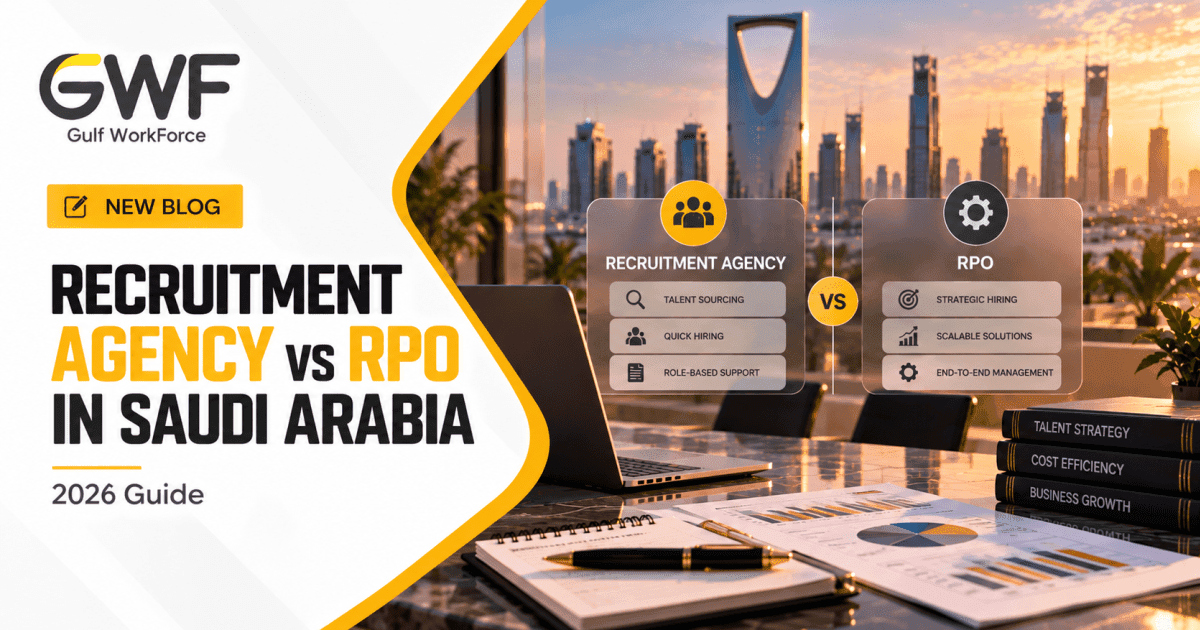
Recruitment Agency vs RPO in Saudi Arabia is the question every enterprise HR Business Partner, Procurement Manager, and Finance Head eventually has to answer once headcount plans in Riyadh, Dammam, or Jeddah move past a handful of one-off hires. Both models can fill Saudi roles compliantly, but they solve different problems: a traditional recruitment agency sources and places candidates against individual requisitions, while Recruitment Process Outsourcing (RPO) embeds a dedicated team inside your hiring function to own sourcing, screening, Saudization tracking, and reporting end-to-end.
Getting this choice wrong is expensive — enterprises defaulting to agency fees for high-volume, ongoing hiring routinely overpay per hire, while companies signing an RPO contract for a single urgent vacancy pay for infrastructure they never use. This guide breaks down the real cost and compliance differences so your buying committee can make the right call for 2026.
40–60% | Up to 35% | 3–10 weeks | 23.5% |
Sources: TASC Outsourcing KSA Hiring Benchmarks 2025–26; Mercans Saudi Arabia GOSI Contribution Rates 2026; General Organization for Social Insurance (GOSI).
What’s Actually Different Between a Recruitment Agency and RPO?
On paper, both a staffing agency and an RPO partner deliver the same outcome — a qualified candidate starts work. In practice, the operating model, pricing logic, and accountability differ structurally, and that’s exactly what an enterprise Procurement or Finance evaluation needs to surface before signing anything.
1. Traditional Recruitment Agency. Works transactionally. You raise a requisition, the agency sources and screens candidates against it, you interview and select, and the agency invoices a placement fee — typically a percentage of first-year salary. Each vacancy is its own engagement; there’s no standing team embedded in your process.
2. RPO (Recruitment Process Outsourcing). A strategic partnership. A dedicated team — on-site or remote — takes ownership of some or all of your recruitment function: sourcing, screening, interview coordination, offer management, Saudization/Nitaqat tracking, and reporting. Pricing is usually a retainer, a per-hire management fee, or a hybrid, built to scale with your hiring volume rather than reset with every new requisition.
💡 Tip. If you’re hiring fewer than 15–20 roles a year in Saudi Arabia across scattered functions, a well-managed agency relationship is usually more cost-efficient than RPO’s retainer overhead. RPO earns its cost back through volume and process efficiency — it needs volume to justify the investment.
How a Traditional Recruitment Agency Operates in the Saudi Market
Agencies remain the default model for Saudi Arabia’s Tier 1 and Tier 2 hiring needs — construction and industrial roles in the Eastern Province, logistics and hospitality staffing in Jeddah, and specialist or executive searches in Riyadh. The agency typically already holds a bank of pre-screened candidates in that vertical, which shortens time-to-first-shortlist considerably.
The trade-off is that each requisition restarts the clock. There’s limited institutional memory of your employer brand or interview standards unless you repeatedly work the same account manager. For a single urgent hire this is a non-issue; for a company running 40+ hires a year across three cities, it shows up as inconsistent candidate experience and duplicated sourcing effort.
How RPO Works for Enterprise Employers in the Kingdom
RPO providers in Saudi Arabia typically structure engagements around three scopes: full-cycle RPO (the provider owns the entire pipeline, requisition to onboarding), project RPO (a fixed-term surge team for a specific hiring wave — a new Riyadh office, a Dammam plant ramp-up), or selective RPO (the provider plugs specific gaps, such as high-volume screening or Saudization documentation, while your team retains other stages).
Because the RPO team is embedded, it can standardize Nitaqat-band tracking, Qiwa contract documentation, and Iqama processing timelines across every hire — an advantage for Procurement and Finance stakeholders who need auditable, consistent compliance reporting across business units rather than a different process per agency per city.
Recruitment Agency vs RPO: Feature Comparison
Dimension | Traditional Recruitment Agency | RPO Partner |
|---|---|---|
Pricing model | Percentage of first-year salary per placement (commonly 15–25%) | Retainer, per-hire management fee, or hybrid — scales with volume |
Best fit | Low-to-moderate volume, one-off or specialist searches | High-volume, ongoing, multi-site or multi-city hiring |
Compliance ownership | Advises on Saudization/Nitaqat per placement; you own the process | Embeds and standardizes Nitaqat, Qiwa, GOSI tracking across all hires |
Scalability | Requisition-by-requisition; scaling means adding more agency relationships | Built to flex team size with hiring demand without renegotiating scope |
Employer branding consistency | Varies by agency and account manager | Managed centrally as part of the engagement |
Reporting for Procurement/Finance | Invoice-by-invoice, limited pipeline visibility | Standardized dashboards, cost-per-hire, time-to-fill by role/city |
Cost Comparison: Agency Fees vs RPO Pricing in Saudi Arabia
The headline number Finance Heads want is cost-per-hire, but the answer depends entirely on volume. A single Riyadh finance-manager placement through an agency at a 20% fee on a SAR 240,000 package costs roughly SAR 48,000 — predictable, one-off. Run that math across 30 hires a year and the total climbs past SAR 1.4 million with no economies of scale, since each placement is priced independently.
RPO pricing is structured differently — a retainer or per-hire management fee that typically falls as volume rises, plus efficiency gains from a standing team that already knows your role profiles, interview panels, and Saudization targets. Industry benchmarking for the Kingdom puts RPO cost-per-hire reductions at up to 35% against comparable agency-fee spend once volume clears roughly 20–25 hires a year, alongside the 40–60% faster turnaround cited above. For the full statutory and on-cost picture beyond recruitment fees, see our guide to the Cost of Hiring an Employee in Saudi Arabia.
⚠️ Warning. Don’t compare RPO retainer cost against agency fees for a single hire and conclude agencies are always cheaper — that’s a fixed monthly cost versus a one-time transaction. The comparison only holds once you annualize both against your actual full-year volume, including recruiter hours and admin overhead your internal team absorbs but doesn’t itemize.
Saudization, Nitaqat, and GOSI: Compliance Ownership Under Each Model
Compliance risk sits differently under each model, and this is where Procurement and Finance due diligence earns its keep. Since Qiwa tightened its rules on 15 April 2026, only Saudi employees whose contracts are Qiwa-documented count toward a company’s Nitaqat Saudization percentage — undocumented contracts can trigger reclassification into a lower band, freezing visa issuance and delaying Iqama renewals.
An agency will generally flag Saudization requirements per placement but leaves ongoing Qiwa documentation and Nitaqat-band monitoring to your HR team. An RPO partner typically builds this tracking into the engagement itself — useful when HR headcount lacks bandwidth to monitor band status across every unit and city.
The cost side is also moving. Under GOSI’s new-system schedule, Saudi national contributions rise from a combined 22.5% (January–June 2026) to 23.5% (July–December 2026) — employer plus employee — while expatriate contributions stay a flat 2% employer-only rate. Either hiring model needs this GOSI step-up baked into the 2026 workforce budget — see our Nitaqat Compliance guide for the full band structure and penalty framework.
Decision Framework: Which Model Fits Your Hiring Scenario
Neither model is universally superior — the right choice depends on volume, urgency, and how much recruitment infrastructure you want in-house versus outsourced.
Hiring Scenario | Recommended Model |
|---|---|
Single urgent vacancy, any city | Recruitment agency |
Specialist/executive search (finance, IT leadership, engineering) | Recruitment agency or boutique executive search |
New office or plant launch requiring 20+ hires in 90 days | Project RPO (fixed-term surge team) |
Ongoing 30+ hires/year across Riyadh, Dammam, and Jeddah | Full-cycle RPO |
High-volume Saudization-linked frontline hiring (retail, hospitality) | Full-cycle or selective RPO with embedded Qiwa/Nitaqat tracking |
Low internal HR bandwidth, need compliance ownership | Full-cycle RPO |
Many enterprise employers in the Kingdom run a blended model — RPO for standing, high-volume roles and a specialist agency for niche searches outside the RPO scope. Before deciding, run your staffing spend through the same criteria used for any enterprise vendor decision — see our guide on how to choose a staffing vendor in Saudi Arabia, and our RPO vs Staffing Agency in the UAE post for how this decision plays out across the border.
Common Mistakes Enterprise Employers Make
Mistake | Cost | How Gulf Workforce Prevents It |
|---|---|---|
Comparing RPO retainer to a single agency fee | Wrong model chosen; overpaying at low volume or underinvesting at high volume | We model cost-per-hire against your actual annual volume before recommending a structure |
Leaving Qiwa documentation to chance across agencies | Nitaqat band downgrade, visa/Iqama freezes | Embedded Qiwa/Nitaqat tracking across every placement, either model |
Ignoring the July 2026 GOSI rate step-up in budgeting | Underbudgeted statutory cost, mid-year Finance surprises | GOSI schedule built into every cost projection we deliver |
Signing a multi-year RPO contract for one-off hiring needs | Paying for standing infrastructure with no volume to justify it | We recommend project or selective RPO scopes when full-cycle isn’t warranted |
How Gulf Workforce Answers This
HR Business Partners — a standardized hiring process across every Saudi location, with Nitaqat-band and Qiwa-documentation tracking built into every placement so compliance reporting stays in sync.
Procurement Managers — transparent pricing under either model: clear placement-fee schedules for agency work, or a scoped RPO retainer with defined SLAs, so vendor comparison during an RFP is apples-to-apples, not guesswork.
Finance Heads — accurate, all-in cost modelling reflecting the 2026 GOSI rate step-up and the real cost-per-hire difference between agency and RPO pricing at your actual volume, not a generic industry average.
Recruiters and TA leads — either a fully embedded sourcing team plugged into your ATS, or a reliable agency partner for specialist searches your team lacks bandwidth to run alone.
The Takeaway
The recruitment agency vs RPO decision in Saudi Arabia isn’t about which model is “better” in the abstract — it’s about matching the model to your hiring volume, urgency, and compliance overhead. Below roughly 20 hires a year, a well-run agency relationship is usually more cost-efficient. Above that threshold, across multiple Saudi cities with Nitaqat and Qiwa obligations to track, RPO’s standing infrastructure typically pays for itself through faster time-to-fill and lower blended cost-per-hire. Evaluate both against your actual annual hiring plan — including the incoming GOSI rate rise — before signing a multi-year commitment to either.
Frequently Asked Questions
1. What is the difference between a recruitment agency and RPO in Saudi Arabia?
A recruitment agency works transactionally, sourcing candidates against individual requisitions and charging a placement fee per hire. RPO (Recruitment Process Outsourcing) embeds a dedicated team inside your hiring function to own sourcing, screening, Saudization tracking, and reporting end-to-end, usually on a retainer, per-hire management fee, or hybrid pricing model.
2. How much do recruitment agencies charge in Saudi Arabia?
Agencies commonly charge 15-25% of first-year salary per placement. For example, a 20% fee on a SAR 240,000 Riyadh finance-manager package costs roughly SAR 48,000, and 30 such hires a year would exceed SAR 1.4 million with no economies of scale.
3. At what hiring volume does RPO become more cost-effective than an agency?
Below roughly 15-20 hires a year, a well-managed agency relationship is usually more cost-efficient. Industry benchmarking for the Kingdom puts RPO cost-per-hire reductions at up to 35% against comparable agency spend once volume clears roughly 20-25 hires a year.
4. What types of RPO engagement are available in Saudi Arabia?
RPO providers typically offer three scopes: full-cycle RPO, where the provider owns the pipeline from requisition to onboarding; project RPO, a fixed-term surge team for a specific hiring wave; and selective RPO, where the provider covers specific gaps such as high-volume screening or Saudization documentation.
5. How do Qiwa rules affect Nitaqat compliance in 2026?
Since Qiwa tightened its rules on 15 April 2026, only Saudi employees whose contracts are Qiwa-documented count toward a company's Nitaqat Saudization percentage. Undocumented contracts can trigger reclassification into a lower band, freezing visa issuance and delaying Iqama renewals.
6. How are GOSI contribution rates changing in 2026?
Under GOSI's new-system schedule, combined employer and employee contributions for Saudi nationals rise from 22.5% (January-June 2026) to 23.5% (July-December 2026). Expatriate contributions stay at a flat 2% employer-only rate.
Ready to Compare Recruitment Agency and RPO Options for Your Saudi Arabia Hiring Plan?
Whichever model fits, Gulf Workforce can scope it for your 2026 volume.
📋 Request an Enterprise Workforce Proposal covering both agency and RPO pricing.
📞 Talk to Our Enterprise Accounts Team about a blended model across Riyadh, Dammam, and Jeddah.
🔍 Get a Vendor Capability Deck comparing our agency and RPO service scopes side by side.
Visit our Employers page or Contact us · info@gulfworkforce.com · +971 4 381 2048