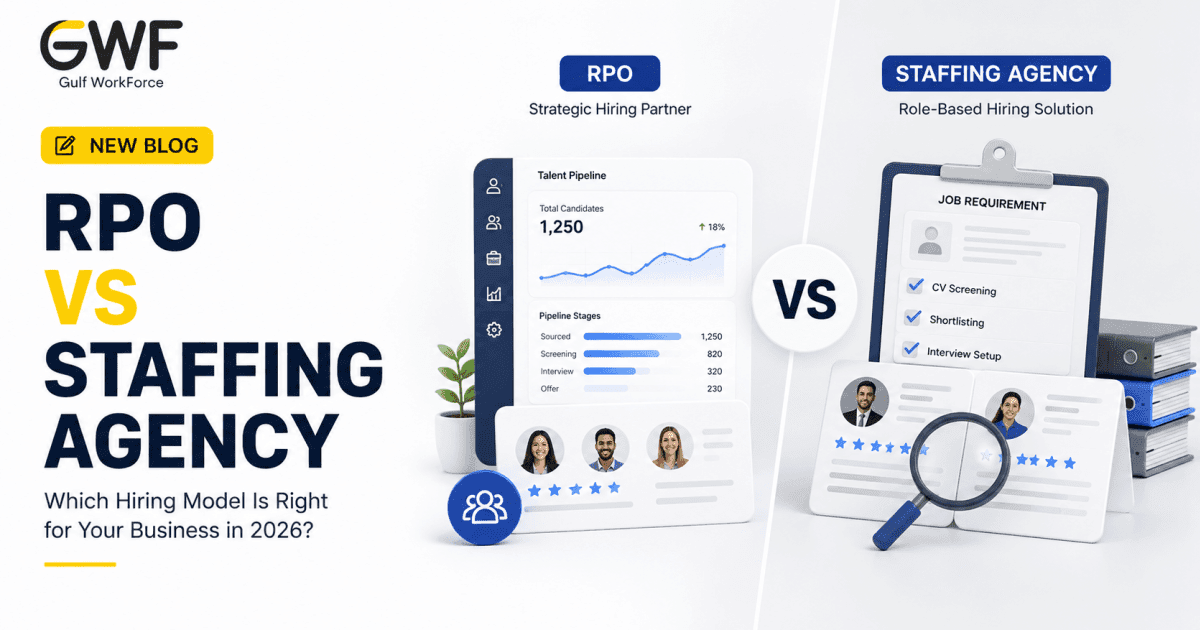
Choosing between RPO vs staffing agency in the UAE is one of the most consequential vendor decisions an enterprise HR or Procurement team will make this year. Get it right, and you cut cost-per-hire, tighten compliance, and give your business a workforce partner that scales with you across Dubai, Abu Dhabi, and the wider GCC. Get it wrong, and you end up locked into a contract that doesn't match how your organization actually hires.
This guide breaks down what each model actually delivers, when to pick one over the other, and how enterprise employers in the UAE are structuring hybrid arrangements in 2026.
$14.2B Global RPO market size, 2026 | $8.9B UAE staffing services market, 2025 | 48% UAE/Saudi firms planning to hire more in 2026 | 40% Execs who say talent supply can't meet specialist needs |
Sources: Grand View Research, Recruitment Process Outsourcing Market Report (2026) · P&S Intelligence, UAE Staffing Service Market (2025) · Robert Walters/Michael Page Gulf Hiring Survey via Khaleej Times (2026)
What Is RPO? What Is a Staffing Agency?
Recruitment Process Outsourcing (RPO) is a model where an external partner takes ownership of some or all of your recruitment function - sourcing, screening, interview coordination, offer management, and sometimes onboarding - operating under your employer brand, using your ATS, and reporting against your hiring KPIs. It's a long-term, embedded partnership, not a transaction.
A staffing agency (also called a manpower supply or recruitment agency) sources and places individual candidates against specific vacancies, typically charging a placement fee or a markup on a contractor's pay rate. The relationship is transactional and role-by-role: you raise a requisition, the agency fills it, and the engagement resets with the next vacancy.
Both models are legitimate ways to build workforce capacity in the UAE - the right choice depends on hiring volume, internal TA maturity, and how much control you want to retain. See our recruitment agency vs manpower supply comparison for the basic distinction between agency-led sourcing and outsourced manpower supply before deciding between RPO and a traditional agency.
RPO vs Staffing Agency: Key Differences at a Glance
Factor | RPO | Staffing Agency |
|---|---|---|
Engagement model | Embedded, long-term partnership | Transactional, per-vacancy |
Best for | High-volume, recurring hiring (50+ roles/year) | Ad hoc, urgent, or specialist single roles |
Pricing structure | Management fee or cost-per-hire model | Percentage of salary or markup on pay rate |
Process ownership | Partner manages your full pipeline under your brand | Agency manages its own pipeline, submits candidates |
Reporting & data | Deep analytics, SLA-driven, integrated with your ATS | Limited visibility beyond submitted CVs |
Contract length | 12–36 months typical | Per-assignment, no lock-in |
Compliance ownership | Shared; partner often manages onboarding compliance | Agency handles compliance for placed contractors only |
When Enterprise Employers Should Choose RPO
RPO earns its cost when hiring is recurring, high-volume, or strategically sensitive. Signs your organization is ready for an RPO model:
You hire 50+ roles a year across one or more UAE locations, or you're scaling a new business unit.
Your internal TA team is stretched thin on operational sourcing and needs to focus on strategic workforce planning instead.
You need consistent employer branding across every candidate touchpoint - RPO recruiters work under your brand, not the vendor's.
Leadership wants hiring data - time-to-fill, source-of-hire, offer-acceptance rate - reported against agreed SLAs, not scattered across vendor emails.
You're consolidating multiple recruitment vendors into one accountable partner to simplify Procurement's vendor list and reduce total cost of workforce.
When a Staffing Agency Model Fits Better
A staffing agency remains the faster, lower-commitment choice for:
Low, unpredictable hiring volume - a handful of roles a year doesn't justify an embedded RPO team.
Urgent, one-off requisitions - a project manager needed within two weeks doesn't wait for an RPO ramp-up.
Niche or executive searches - specialist headhunting for a single senior hire is usually better served by a boutique agency with a deep network in that vertical.
Testing a new market or role type - before committing to a long-term partner, agencies let you validate demand with no lock-in.
Temporary and contract staffing - flexible workforce needs (seasonal surges, project-based contractors) are the traditional strength of the agency model.
💡 Tip. If your organization is opening a new site in the UAE and needs 80–150 hires within two quarters, an RPO engagement typically brings cost-per-hire down 20–30% versus running the same volume through multiple staffing agencies in parallel - because a single embedded team avoids duplicate sourcing spend and fee stacking.
Cost, Compliance, and MOHRE Considerations in the UAE
Whichever model an enterprise employer chooses, compliance sits with the business, not just the vendor. The UAE's Ministry of Human Resources and Emiratisation (MOHRE) now issues 13 distinct work permit types through a unified digital platform, having cut mandatory data fields by up to 97% for some permit categories - a meaningful compliance shift for any organization hiring at volume in 2026.
Employers bringing in overseas talent should also track residency and entry-permit requirements through the General Directorate of Residency and Foreign Affairs (GDRFA), particularly for Dubai-based hiring where residency processing runs through GDRFA rather than federal channels alone.
For Finance Heads, the real comparison isn't the headline fee - it's total cost of workforce: agency placement fees plus internal TA overhead plus the cost of extended vacancies, versus an RPO management fee that typically scales down per-hire as volume increases. See our HR outsourcing company guide for how to structure that comparison across a full outsourcing scope, not just recruitment.
⚠️ Warning. Don't sign a multi-year RPO contract based on projected hiring volume alone. Build a volume-flex clause into the SLA - enterprise hiring plans in the UAE shift with project timelines, and a rigid RPO contract sized for 100 hires a year becomes expensive dead weight if volume drops to 40.
Hybrid Models: Combining RPO and Staffing for Enterprise Flexibility
Most large UAE employers don't run a pure model. A common structure: RPO handles the predictable, high-volume core (standard roles, recurring headcount, multi-site onboarding), while a shortlist of specialist staffing agencies is retained for executive search, niche technical roles, and short-notice contractor cover. This hybrid approach lets Procurement consolidate the bulk of spend under one accountable RPO partner while keeping the flexibility agencies provide for edge cases - often the most cost-efficient structure once total hiring volume crosses roughly 40–50 roles a year. It pairs naturally with a broader enterprise workforce solutions strategy, and with a dedicated permanent recruitment services track for roles that sit outside either the RPO scope or agency bench.
Common Mistakes Enterprise Buyers Make
Mistake | Cost | How Gulf Workforce Prevents It |
|---|---|---|
Sizing an RPO contract on projected volume alone | Overpaying for idle capacity when hiring slows | Volume-flex clauses built into every SLA |
Comparing agency fee % to RPO fee without total-cost math | Choosing the model that looks cheaper, not the one that is cheaper | Total-cost-of-workforce modeling provided upfront |
No compliance clause for MOHRE/GDRFA permit categorization | Fines, delayed start dates, blocked visa issuance | Compliance ownership defined contractually from day one |
How Gulf Workforce Answers This
Visit our Employers page to see how we structure both models, or contact our team directly:
HR Business Partners get a single point of accountability for headcount forecasting, standardized onboarding across sites, and quality-of-hire reporting instead of chasing multiple vendor threads.
Procurement Managers receive transparent SLA and contract terms, a documented vendor risk/compliance profile, and the option to consolidate multiple recruitment vendors onto a single preferred supplier agreement.
Finance Heads get a clear total-cost-of-workforce model — cost-per-hire, management fee structure, and payroll/compliance risk exposure — so budget forecasting doesn't rely on guesswork.
Recruiters and in-house TA leads get either a fully embedded RPO extension of their own team or a vetted staffing bench for overflow and specialist roles, with ATS-integrated reporting either way.
The Takeaway
There's no universally "better" model- only the model that matches your hiring volume, timeline, and internal capacity. High-volume, recurring, strategically important hiring favors RPO; urgent, low-volume, or niche hiring favors a staffing agency; most enterprise employers in the UAE eventually land on a hybrid of both. The decision worth getting right isn't RPO vs staffing agency in the abstract - it's which combination fits your actual 2026 hiring plan.
Frequently Asked Questions
What is the main difference between RPO and a staffing agency?
RPO is an embedded, long-term partnership where an external partner manages your full recruitment pipeline under your employer brand and ATS. A staffing agency is transactional and per-vacancy - you raise a requisition, the agency fills it from its own pipeline, and the engagement resets with the next role.
How many hires a year justifies switching to an RPO model?
RPO typically earns its cost once an organization is hiring 50 or more roles a year across UAE locations, or scaling a new business unit. Below that volume, the embedded team and management overhead usually aren't justified.
Can enterprise employers in the UAE combine RPO and staffing agencies?
Yes - most large UAE employers run a hybrid: RPO handles predictable, high-volume core hiring, while a shortlist of specialist staffing agencies covers executive search, niche technical roles, and short-notice contractor needs. This is often most cost-efficient once volume crosses roughly 40-50 roles a year.
What UAE compliance bodies matter when choosing a hiring model?
MOHRE (Ministry of Human Resources and Emiratisation) issues work permits through a unified digital platform, while the General Directorate of Residency and Foreign Affairs (GDRFA) governs residency and entry-permit processing - particularly relevant for Dubai-based hiring, where GDRFA handles residency rather than federal channels alone.
Why shouldn't an RPO contract be sized on projected hiring volume alone?
Enterprise hiring plans in the UAE shift with project timelines, so a rigid multi-year RPO contract sized for a fixed volume (e.g. 100 hires a year) becomes expensive dead weight if actual volume drops. A volume-flex clause built into the SLA protects against this.
Not Sure Which Model Fits Your Hiring Plan?
Gulf Workforce structures RPO, staffing, and hybrid engagements for enterprise employers across the UAE and GCC.
📋 Request an Enterprise Workforce Proposal built around your actual hiring volume and timeline.
📞 Talk to Our Enterprise Accounts Team about structuring an RPO, staffing, or hybrid engagement.
🔍 Get a Vendor Capability Deck to bring back to your Procurement or HR leadership.