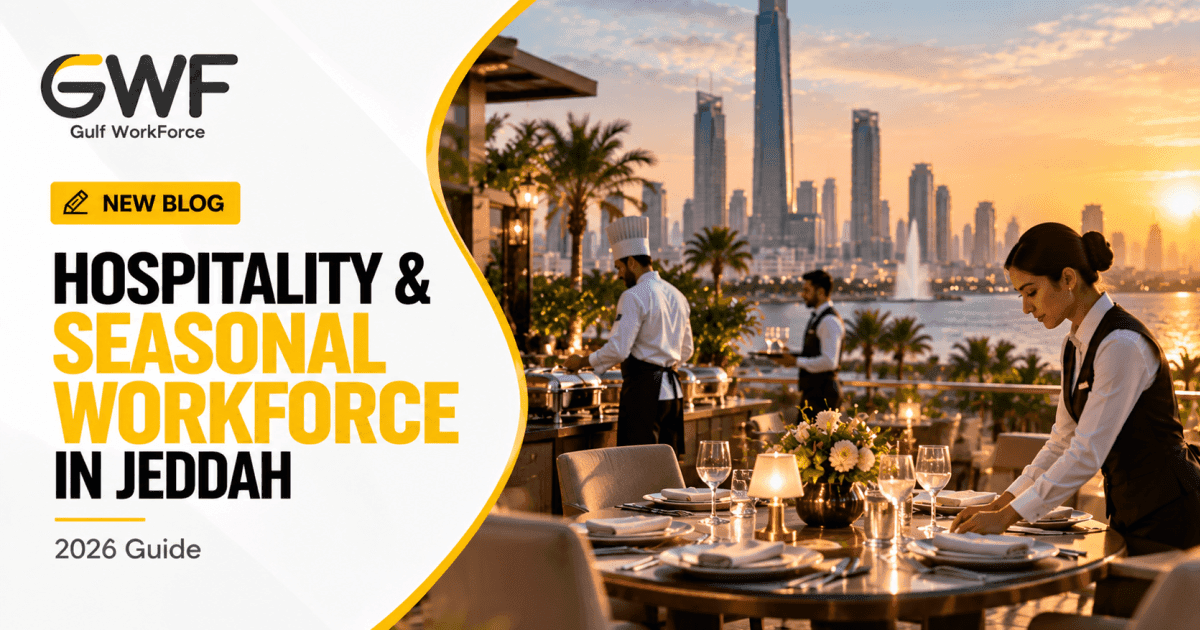
For enterprise employers operating in Jeddah, hospitality and seasonal workforce staffing in Jeddah is not a generic hiring problem - it is a compliance-heavy, calendar-driven challenge shaped by the city's role as the Kingdom's primary gateway for Hajj and Umrah pilgrims. Jeddah's hotels, catering operations, transport providers, and event venues absorb some of the sharpest seasonal demand spikes in the GCC, and getting the workforce model wrong - understaffing peak arrivals or overcommitting to permanent headcount that sits idle off-season carries a direct cost to guest experience, compliance exposure, and margin. This guide sets out how HR, Procurement, and Finance leaders should plan it for 2026 and beyond.
1,707,301 | 15.2M+ | 53.4M | 171,650 |
Sources: General Authority for Statistics (GASTAT) via the Saudi Press Agency, May 2026; Vision2030.ai/General Authority of Civil Aviation, 2025; Knight Frank KSA Hospitality & Religious Tourism Report, 2026.
Why Jeddah's Hospitality Workforce Demand Is Different From Anywhere Else in Saudi Arabia
Riyadh's staffing demand is corporate and government-driven; Dammam and the Eastern Province run on industrial and petrochemical labour cycles. Jeddah is different: it is the Kingdom's primary gateway for religious tourism, and its hospitality sector runs two demand curves at once - a steady corporate/leisure baseline, and extreme seasonal peaks tied to the Islamic calendar.
King Abdulaziz International Airport processed a record 53.4 million passengers in 2025, 38% of all Kingdom passenger traffic, and its dedicated Hajj Terminal is built to process more than one million pilgrims across a single season. Jeddah is also tied with Riyadh as the top metropolitan destination for domestic Saudi travellers, at roughly 40% preference share, per Knight Frank's 2026 hospitality analysis.
For an enterprise employer - a hotel group, a contract caterer, a ground-transport operator, an events company, or a facilities-management provider - that combination means Jeddah's hospitality workforce plan has to do two things a Riyadh or Dammam plan does not: flex hard around fixed religious-calendar dates, and comply with a temporary-labour regulatory framework built specifically around Hajj and Umrah service provision. This sits alongside Jeddah's existing enterprise staffing demand in port, freight, and warehouse logistics, which peaks on many of the same Hajj/Umrah seasonal cycles.
💡 Tip. Build your Jeddah seasonal workforce calendar around three demand tiers, not two. Hajj itself is a short, extremely intense fixed-date peak; Ramadan/Umrah season is a longer, high-volume but somewhat more elastic surge; and the year-round Umrah baseline (now over 15 million performers in a single quarter) means Jeddah's hospitality sector rarely has a true "quiet" period the way seasonal markets elsewhere do.
What Enterprise Employers Are Actually Staffing For During Peak Season
Seasonal demand in Jeddah's hospitality and pilgrimage-adjacent economy spans several distinct role categories, each with different sourcing, skill, and compliance requirements:
Hotel operations roles - front desk, housekeeping, and food-and-beverage service - scale sharply around Hajj and Ramadan, when occupancy in the Holy Cities corridor regularly outperforms the national average. Saudi Arabia's national hotel stock stood at 171,650 rooms as of late 2025, with average daily rate at roughly SAR 746 and occupancy near 61% nationally. Catering and F&B production staff are needed at a scale most in-house teams cannot resource internally, particularly for institutional pilgrim-services contracts.
Ground transport staff move pilgrims and guests between the airport, hotels, and the Holy Cities. Guest services and multilingual staff are in short supply given the international profile of Hajj and Umrah travellers, and event/crowd-management support rounds out the picture for Jeddah's growing exhibition and corporate events calendar.
None of this suits a purely in-house, permanent-headcount hiring model. It is also not the "mass" or "bulk" hiring this project deliberately avoids - it is structured, compliance-audited, short-duration surge staffing under Saudi Arabia's own temporary-work-authorization system, a materially different proposition for a Procurement or Finance stakeholder assessing vendor risk.
In-House Team, Local Agency, or Enterprise Workforce Partner: A Comparison
Staffing Model | Speed to Scale for Peaks | Ajeer/Permit Compliance Ownership | Best Fit |
|---|---|---|---|
In-house recruitment | Slow - permanent hiring cycles measured in weeks | Fully on the employer, including Nitaqat exposure | Small, stable headcount with predictable, non-seasonal demand |
Single local agency | Moderate - limited by one supplier's Jeddah bench | Shared, often unclearly documented | Single-property operations with modest seasonal swings |
Enterprise workforce partner | Fast - pre-vetted multi-site bench plus Ajeer-eligible surge capacity | Contractually defined, Nitaqat- and Ajeer-audited | Hotel groups, contract caterers, multi-site event operators, transport providers |
The Ajeer System: How Temporary Hajj and Umrah Staffing Is Actually Regulated
Saudi Arabia's Ministry of Human Resources and Social Development (MHRSD) governs temporary labour-sharing through the Ajeer electronic platform, which allows businesses to source workers for fixed-duration assignments - from a few days to several months - without transferring an employee's Iqama sponsorship.
Ajeer explicitly covers "Hajj and festival events" seasonal labour alongside hospitality, cleaning, and facility-maintenance secondments. To use it, an employer must hold at least a medium-green Nitaqat (Saudization) rating, maintain valid commercial and municipal registrations, and only deploy workers whose Iqama has at least three months of remaining validity. Non-compliance is not minor: penalties run up to SAR 5,000 per worker per violation, alongside potential suspension of hiring quotas and negative marks in labour audits.
For a Procurement Manager evaluating a staffing vendor for Jeddah's peak season, Ajeer eligibility should be a hard qualifying criterion, not a nice-to-have. A vendor without a medium-green or better Nitaqat rating cannot legally deploy Ajeer-based temporary staff, however competitive the quoted rate looks.
See MHRSD's guidance on temporary work arrangements at hrsd.gov.sa, and use the Qiwa platform to verify a vendor's Nitaqat status before contracting. For the broader Nitaqat band mechanics behind the medium-green threshold, see our Nitaqat compliance guide for enterprise employers.
The 2024–2025 Regulatory Update Enterprise Employers Still Need to Account For
In October 2024, Saudi Arabia's Council of Ministers approved an updated regulation governing temporary work visas specifically for Hajj and Umrah services, effective from April 2025 and still the operative framework through the 2026 season. The update extended the seasonal temporary-visa window - running from the fifteenth of Sha'ban until the end of Muharram - giving employers a longer runway to bring in temporary Hajj/Umrah-service labour than before.
It also abolished a prior visa-endorsement requirement, added a dedicated penalties chapter against abuse of the temporary-visa route, and introduced a 90-day renewal option for employers whose seasonal demand runs longer than one permit cycle. Mandatory medical insurance before visa issuance abroad is now fixed, alongside signed employment contracts retained by both employer and worker.
⚠️ Warning. Do not assume a temporary Hajj/Umrah work visa can be issued, renewed, or extended informally. Since the 2024–2025 update, medical insurance must be arranged before the visa is even issued abroad, and the regulation now carries a dedicated penalties framework for misuse of the temporary-visa route. A staffing vendor that treats this as paperwork to backfill after workers have already arrived is exposing your organisation, not just itself, to compliance risk.
Common Staffing Mistakes During Jeddah's Peak Season
Mistake | Cost | How Gulf Workforce Prevents It |
|---|---|---|
Contracting a vendor without a medium-green Nitaqat rating | Workers cannot legally be deployed under Ajeer; last-minute scramble for cover during peak dates | Vendor Nitaqat status verified via Qiwa before any contract is signed |
Starting temporary visa processing after the Sha'ban window opens | Missed peak-week coverage; workers arrive after the demand spike has passed | Seasonal headcount plans built 90-120 days ahead of the Hajj/Umrah calendar |
Treating Hajj and year-round Umrah demand as one undifferentiated "busy season" | Over- or under-resourcing against the wrong demand curve | Three-tier demand planning (Hajj peak, Ramadan/Umrah surge, year-round baseline) |
How Gulf Workforce Answers This
For the HR Business Partner planning headcount across a multi-property Jeddah portfolio - Gulf Workforce maintains a pre-screened, Ajeer-eligible bench of hospitality, catering, and guest-services talent deployable against the Hajj, Ramadan/Umrah, and year-round demand tiers without building permanent headcount for temporary peaks.
For the Procurement Manager running vendor selection - we provide verifiable Nitaqat status, documented Ajeer permit history, and contractual SLAs covering deployment lead time and coverage guarantees during fixed pilgrimage dates - the criteria a staffing RFP for Jeddah's seasonal market should demand.
For the Finance Head modelling total cost of workforce - we structure seasonal staffing costs transparently against the temporary-visa framework (medical insurance, 90-day renewal cycles, Ajeer permit fees), building on the same cost components covered in our Saudi Arabia cost-of-hiring guide, so seasonal labour cost is planned, not discovered after the fact.
For the Recruiter or in-house TA lead - we absorb sourcing for roles genuinely hard to fill on short notice — multilingual guest services, banquet and event staff, skilled catering production — while your team stays focused on permanent, strategic hires.
The Takeaway
Hospitality and seasonal workforce staffing in Jeddah cannot be planned the way generic hospitality hiring is elsewhere. The city's role as the Kingdom's primary Hajj and Umrah gateway means demand is calendar-driven, temporary-labour compliance is specific and actively enforced, and the cost of getting the workforce model wrong - under-resourcing peak dates or contracting a non-compliant vendor - is measured in guest experience and regulatory exposure alike. An enterprise workforce partner with a verified Ajeer-eligible bench and documented Nitaqat rating turns that seasonal complexity into a planned, budgeted, compliant operation.
Frequently Asked Questions
1. What is the Ajeer system and how does it apply to Hajj and Umrah staffing in Jeddah?
Ajeer is MHRSD's electronic platform for temporary labour-sharing in Saudi Arabia. It lets businesses source workers for fixed-duration assignments — from a few days to several months — without transferring an employee's Iqama sponsorship, and it explicitly covers "Hajj and festival events" seasonal labour alongside hospitality, cleaning, and facility-maintenance secondments.
2. What Nitaqat rating does a staffing vendor need to use Ajeer for Hajj and Umrah deployments?
An employer or vendor must hold at least a medium-green Nitaqat (Saudization) rating, maintain valid commercial and municipal registrations, and only deploy workers whose Iqama has at least three months of remaining validity. A vendor below medium-green cannot legally deploy Ajeer-based temporary staff.
3. What changed in the 2024-2025 regulatory update for temporary Hajj and Umrah work visas?
Saudi Arabia's Council of Ministers approved an updated regulation in October 2024, effective April 2025, that extended the seasonal temporary-visa window (from the fifteenth of Sha'ban until the end of Muharram), abolished a prior visa-endorsement requirement, added a dedicated penalties chapter for misuse of the temporary-visa route, and introduced a 90-day renewal option. Mandatory medical insurance before visa issuance abroad is also now fixed.
4. Which roles see the sharpest seasonal staffing demand in Jeddah during Hajj and Ramadan?
Hotel operations roles (front desk, housekeeping, food-and-beverage service), catering and F&B production staff, ground transport staff, guest services and multilingual staff, and event/crowd-management support all scale sharply during peak pilgrimage periods.
5. What are the penalties for Ajeer non-compliance in Saudi Arabia?
Penalties run up to SAR 5,000 per worker per violation, alongside potential suspension of hiring quotas and negative marks in labour audits for the employer or vendor involved.
6. How far in advance should employers start planning Jeddah's seasonal hospitality workforce?
Seasonal headcount plans should be built 90-120 days ahead of the Hajj/Umrah calendar. Starting temporary visa processing only after the Sha'ban window opens typically means workers arrive after the demand spike has already passed.
Plan Your 2026 Jeddah Seasonal Workforce Now
Whether you need Hajj-peak coverage, Ramadan/Umrah surge staffing, or a year-round hospitality bench for Jeddah, Gulf Workforce builds Ajeer-eligible, Nitaqat-verified staffing plans for enterprise employers.
📋 Request an Enterprise Workforce Proposal
📞 Talk to Our Enterprise Accounts Team
🔍 Get a Vendor Capability Deck covering our Jeddah seasonal staffing bench and compliance documentation