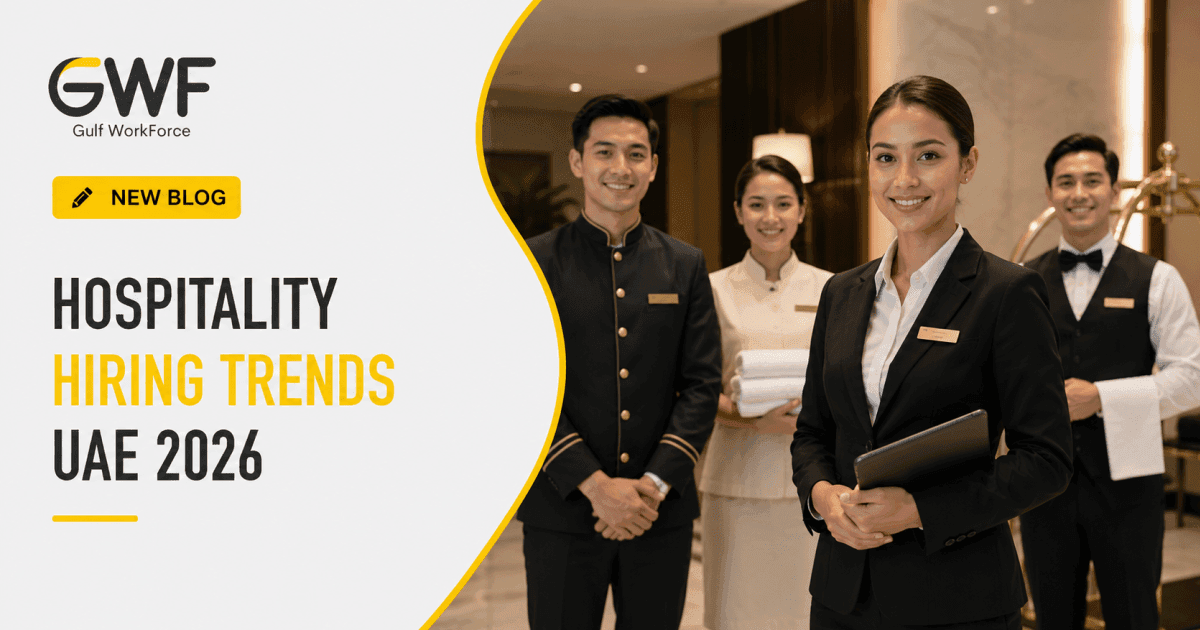
Hospitality Hiring Trends UAE 2026: What Hotel & HORECA Employers Need to Know
By Gulf Workforce | Published: July 2026 | Sources: Gulf News (May 2026) · The National (April 2026) · SOEG Consulting · Leverage Edu · Cavendish Maxwell
The UAE hospitality sector entered 2026 in a state of recalibration. After years of aggressive post-pandemic expansion, hotel operators and HORECA businesses are now hiring with more discipline - building leaner, multi-skilled teams rather than simply scaling headcount.
For employers, this shift changes how you hire, who you hire, and what you pay. For recruitment partners, it demands a deeper understanding of the market than a simple list of open vacancies.
This guide - written by the Gulf Workforce team based on current 2026 UAE market data - covers the six defining hospitality hiring trends of 2026, role-by-role salary benchmarks, overseas sourcing realities, and a practical employer action checklist.
Market context (May 2026): Dubai's hotel room inventory is projected to reach 161,218 rooms by end of 2026 (Cavendish Maxwell). UAE hotel occupancy remains above 80% - the highest in the Middle East. Simultaneously, a wave of hotel renovations has created a short-term hiring pause, with operators redesigning workforce models for the next phase of growth.
1. The Real 2026 Story: Lean, Multi-Skilled, Tech-Driven Hiring
The headline that most hospitality guides are not writing in 2026 is this: UAE hotels are not simply hiring more people. They are hiring differently.
According to Gulf News reporting from May 2026, hospitality groups across the UAE are redesigning their workforce models following a wave of property renovations. Rather than returning to pre-existing staffing levels, operators are focusing on three things:
Multi-skilled employees - staff who can move between F&B, guest relations, and events coverage rather than being locked into a single function
Tighter team structures - fewer employees per property, with performance managed more rigorously through data and KPIs
Technology-led operations - property management systems (PMS), AI scheduling tools, and digital concierge platforms reducing the administrative headcount required
Klaus Assmann, CEO for the Middle East, India and Southeast Asia at United Hospitality Management, described it clearly: the market is undergoing a phase of caution and recalibration, with companies hiring with more discipline and intention rather than scaling aggressively.
For employers, this means two things: your job descriptions need to evolve, and your salary benchmarks need to reflect the wider scope now expected of each hire.
2. Six Hospitality Hiring Trends Shaping the UAE in 2026
Hiring Trend | What It Means for Employers | Action Required |
Multi-skilling over headcount | Hotels hiring fewer but more versatile staff. One employee covering F&B + guest relations + events. | Rewrite JDs to reflect multi-role expectations. Adjust pay to reflect wider scope. |
Tech-driven operations | PMS, AI scheduling, and digital concierge tools reducing need for some admin roles. | Hire tech-literate candidates. Factor digital proficiency into screening criteria. |
RAK & Northern Emirates expansion | Wynn Al Marjan, new eco-resorts creating 5,000+ new jobs outside Dubai. | Extend sourcing reach beyond Dubai. Different salary expectations apply. |
Year-round demand (not seasonal) | Staffing needs no longer peak-driven - consistent year-round pressure. | Move from seasonal to permanent hire model. Reduce over-reliance on temp contracts. |
Overseas sourcing as primary channel | Philippines, India, Nepal remain top source markets for operational roles. | Engage agencies with active overseas pipelines. Allow 6–10 weeks for mobilisation. |
Retention over recruitment | High attrition costing hotels AED 8,000–15,000 per replacement hire. | Invest in onboarding, career pathing, and service charge transparency upfront. |
3. UAE Hospitality Salary Benchmarks 2026 - Role by Role
Salary benchmarks in UAE hospitality shifted notably in 2026. High-demand roles including F&B Managers, Executive Chefs, and Revenue Managers saw increases of 10 to 15% driven by record tourism numbers and new hotel openings (SOEG Consulting, 2026). Entry to mid-level operational roles saw more modest growth of 5 to 8%.
All figures below are monthly base salary in AED and are fully tax-free. Most operational roles include accommodation, meals, transport, and medical insurance - adding 20 to 35% in effective package value on top of the base.
Role | Level | Monthly Salary (AED) | Benefits Typically Included |
Hotel General Manager | Executive | 35,000 – 60,000 | Housing, car, schooling, medical, flight |
Director of F&B | Senior Mgmt | 20,000 – 35,000 | Housing allowance, medical, annual flight |
Executive Chef | Senior Mgmt | 15,000 – 25,000 | Housing, meals, medical, annual flight |
Revenue Manager | Mid–Senior | 12,000 – 22,000 | Housing allowance, medical insurance |
Front Office Manager | Mid-level | 8,000 – 15,000 | Housing allowance, medical insurance |
Housekeeping Manager | Mid-level | 7,000 – 13,000 | Accommodation or allowance, medical |
Guest Relations Officer | Junior–Mid | 5,000 – 10,000 | Accommodation, meals, transport, medical |
Sous Chef / Chef de Partie | Junior–Mid | 6,000 – 14,000 | Accommodation, meals, transport, medical |
F&B Supervisor | Junior–Mid | 5,000 – 9,000 | Accommodation, meals, transport, medical |
Waiter / Waitress | Entry | 3,500 – 5,500 + service charge | Accommodation, meals, transport, medical |
Housekeeping Attendant | Entry | 1,500 – 3,000 + benefits | Accommodation, meals, transport, medical |
Important note on service charge: In UAE hotels, service charge distributions can add AED 300 to 800 per month for operational staff. However, under UAE labour law, service charges, tips, and accommodation are excluded from end-of-service gratuity calculations — only fixed monthly basic salary counts. Always communicate this clearly to candidates during the offer stage.
4. Overseas Sourcing - The Primary Talent Channel for UAE Hospitality
The majority of operational hospitality roles in the UAE are filled through overseas sourcing - primarily from South and Southeast Asia. Local UAE talent predominantly fills supervisory, management, and specialist roles. Understanding this dynamic is essential for any employer planning a hospitality hiring drive in 2026.
Source Country | Strongest For | Avg. Mobilisation Time | Key Strength |
Philippines | F&B service, guest relations, housekeeping supervisors | 6 – 8 weeks | English proficiency, luxury service training, warm demeanour |
India | Chefs, kitchen staff, F&B, accounts, management | 4 – 6 weeks | Large talent pool, strong culinary expertise, UAE familiarity |
Nepal | Housekeeping, security, stewarding, kitchen support | 5 – 7 weeks | Strong work ethic, physical roles, cost-effective |
Sri Lanka | Housekeeping, F&B service, front office | 5 – 7 weeks | Service-oriented culture, hotel chain experience |
Pakistan | Kitchen, F&B, security, facilities management | 4 – 6 weeks | Large skilled pool, strong UAE familiarity |
UAE Local Market | Supervisors, managers, head chefs, senior roles | 1 – 3 weeks | No visa processing, immediate availability |
End-to-end overseas mobilisation involves GAMCA medical clearance, document attestation, visa processing through MOHRE, and flight and accommodation coordination. Employers who underestimate this timeline - particularly those planning a hotel opening or peak season ramp-up - consistently face delays that affect operational readiness.
Gulf Workforce tip: If your target go-live date is fixed, count backwards from it. For overseas candidates, build in a minimum of 8 weeks from offer acceptance to boots on the ground. For UAE-based candidates, allow 2 to 4 weeks for notice periods and onboarding. Engage your recruitment partner at least 12 weeks before your operational deadline.
5. Ras Al Khaimah and Northern Emirates - The New Hospitality Hiring Frontier
Dubai dominates UAE hospitality, but 2026 is the year Ras Al Khaimah moved from emerging market to active hiring destination. Several landmark developments are reshaping the talent landscape outside Dubai:
Wynn Al Marjan Island Resort - the first legal casino resort in the Arab world, expected to create over 5,000 direct hospitality jobs when fully operational. Roles span gaming, F&B, guest services, security, and facilities management.
Sharjah cultural tourism expansion - new museum, heritage, and boutique hotel openings are generating demand for bilingual (Arabic-English) guest relations and cultural programme staff.
Fujairah eco-luxury resorts - growing eco-tourism infrastructure is creating demand for sustainability-focused hospitality professionals with outdoor activity and wellness programme experience.
For employers hiring in RAK and the Northern Emirates, salary expectations differ from Dubai - typically 10 to 20% lower on base salary, offset by fully-provided accommodation and meals. Candidates with Dubai hotel experience who are open to RAK postings are in strong demand and can command faster progression to supervisory roles.
6. Retention: The Hiring Problem Nobody Talks About
Recruiting a hospitality employee is only half the challenge. Retaining them - particularly at operational levels - is where most UAE hotels struggle in 2026.
Industry data indicates that replacing a hospitality employee at operational level costs between AED 8,000 and AED 15,000 when you account for agency fees, visa processing, training time, and lost productivity during the transition. High attrition is not just an HR problem - it is a direct cost to the business.
The most common drivers of early attrition in UAE hospitality:
Unclear service charge structure - candidates who discover the service charge breakdown is lower than expected after joining are a significant attrition risk within the first 90 days
Accommodation quality gap - staff houses that do not match what was described during recruitment create immediate dissatisfaction
No clear career progression - operational staff who see no pathway to supervisory roles leave for competitors who offer structured development
Delayed or inconsistent pay - WPS compliance is mandatory, but late processing of allowances or inconsistent service charge payments generate grievances fast
High-retention employers in UAE hospitality do three things better than others: they are fully transparent about the total package (base + service charge + benefits) before offer, they provide a structured 30-day onboarding plan, and they map out a 12-month career path during the first week of employment.
7. The Hospitality Roles in Highest Demand Across the UAE in 2026
Based on active Gulf Workforce mandates and market intelligence from across the UAE hospitality sector, these are the roles with the most consistent employer demand in 2026:
Executive Chef and Sous Chef: New restaurant openings and hotel F&B rebrands are generating consistent demand. Candidates with luxury hotel chain experience (Marriott, Hilton, Four Seasons, Jumeirah) and multiple cuisine expertise are prioritised.
F&B Manager and F&B Supervisor: As hotels shift to multi-outlet F&B models, managers who can oversee multiple concepts simultaneously are commanding the strongest offers. Arabic language skills add a measurable salary premium.
Revenue Manager: Dynamic pricing and yield management are now board-level priorities for UAE hotels competing on RevPAR. Candidates with Opera PMS and channel manager experience are in acute demand.
Guest Relations Officer: Luxury properties are rebuilding guest experience teams post-renovation. Multi-lingual candidates - particularly those combining English with Russian, Chinese, or Arabic - are prioritised.
Housekeeping Supervisor: Post-renovation ramp-ups require experienced supervisors who can build and train new teams from scratch. Philippines and Nepal remain the strongest source markets for this role.
Event Coordinator: UAE's MICE (meetings, incentives, conferences, exhibitions) sector is growing strongly. Coordinators with experience in corporate and luxury social events are in consistent demand across Dubai and Abu Dhabi.
8. Employer Action Checklist: Hospitality Hiring in the UAE in 2026
Use this checklist to audit your current hospitality hiring strategy against 2026 market realities:
Action Item | Priority | Timeline |
Audit current workforce for multi-skilling gaps | High | Immediate |
Review JDs to reflect 2026 multi-role expectations | High | This month |
Benchmark salaries against 2026 UAE market data | High | This month |
Engage overseas sourcing pipeline for operational roles | High | 6–10 weeks lead time |
Map RAK / Northern Emirates roles separately from Dubai | Medium | Q3 2026 |
Review onboarding and retention programme | Medium | Next 60 days |
Assess PMS and scheduling technology stack | Medium | Q3 2026 |
Partner with specialist hospitality recruitment agency | High | Immediate |
Need a Hospitality Recruitment Partner in the UAE?
Gulf Workforce is a Dubai-based recruitment consultancy specialising in hospitality and HORECA staffing across the UAE. We place chefs, F&B managers, guest relations teams, housekeeping supervisors, and operational staff for hotels, restaurants, and event venues - from single hires to full venue openings. We source locally and internationally, manage visa and compliance processes end to end, and deliver job-ready candidates on your timeline.
Tell us your headcount, roles, and go-live date. We will send you a sourcing plan within 24 hours.
Email: hello@gulfworkforce.com
Phone: +971 4 353 8329
Website: gulfworkforce.com