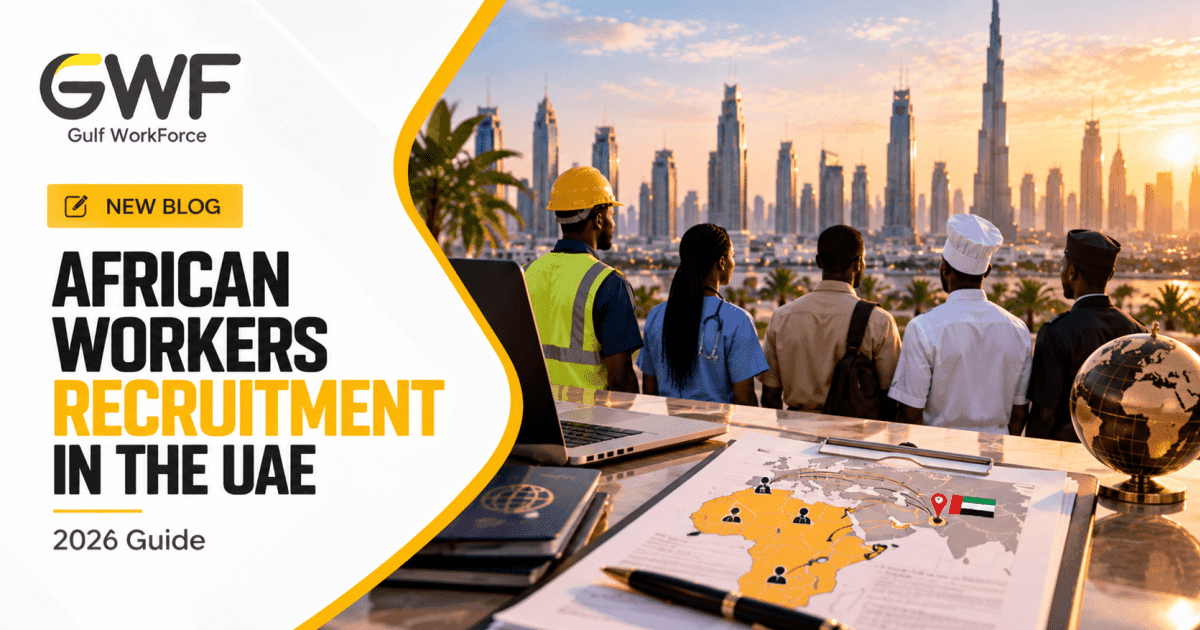
For enterprise employers building a resilient, multi-country labour supply chain, an African Workers Recruitment Agency in the UAE is fast becoming a standard line item on the vendor panel rather than an experimental add-on.
Kenya, Uganda, Ethiopia, Nigeria, and Ghana now supply a growing share of the construction, hospitality, logistics, security, and facility-management workforce entering the UAE under formal bilateral labour agreements and MOHRE-licensed recruitment channels - and Procurement, HR, and Finance leaders are moving deliberately to diversify beyond the traditional South Asian corridors that have long dominated blue-collar sourcing.
This guide sets out the legal framework, the real 2026 cost and remittance data behind the trend, and the vetting steps enterprise buyers need before adding an African-sourcing lane to their workforce strategy.
70,000+Ugandans working in the UAE under the 2021 bilateral labour MoU | $2.8BUganda diaspora remittances, 12 months to March 2026 (+47% YoY) | $5.24BKenya's projected 2026 diaspora remittances, partly Gulf-driven | 27Countries barred from one GCC domestic-worker channel in 2026 |
Sources: Khaleej Times (UAE–Uganda labour MoU); Uganda Ministry of Finance June 2026 budget speech (via Daily Monitor); Central Bank of Kenya 2026 remittance projection (via Business Daily Africa); Daily Monitor (Kuwait domestic-worker recruitment ban, 2026).
Why Enterprise Employers Are Turning to African Labour Markets in 2026
An African Workers Recruitment Agency in the UAE connects enterprise employers with government-vetted, MOHRE-registered sourcing channels across East and West Africa, and demand for exactly this kind of compliant intermediary has grown sharply through 2026. Traditional South Asian corridors remain the backbone of UAE blue-collar hiring, but Procurement and HR leaders are diversifying supply chains for talent the same way they diversify supply chains for materials - to reduce single-source risk and tap into large, youthful, English-speaking labour pools in Kenya, Uganda, Ethiopia, Nigeria, and Ghana.
The economics support the shift. Kenya's diaspora remittances - a proxy for how much the Gulf specifically contributes to Kenyan household income - are projected by the Central Bank of Kenya to reach roughly $5.24 billion in 2026, with the CBK explicitly attributing part of that growth to a “recovery in inflows from Saudi Arabia.” Uganda's numbers moved even faster: diaspora remittances hit $2.8 billion in the twelve months to March 2026, up 47% year-on-year, per the country's own Finance Minister. Enterprise employers reading those figures see a labour-exporting region under real economic pressure to place workers well, and a UAE government framework already built to receive them.
The Legal Framework: Bilateral Labour Agreements and MOHRE Licensing
Unlike an ad-hoc “we know someone in Nairobi” arrangement, a properly structured African Workers Recruitment Agency in the UAE operates inside a bilateral legal framework, not around it. The UAE, through its Ministry of Human Resources and Emiratisation (MOHRE), has signed government-to-government labour MoUs with Kenya (2018) and Uganda (2021) that require every placement to run through licensed agencies on both ends, register the employment contract before travel, and give the worker the right to review and approve terms before signing.
💡 Check both licences. Before engaging any African-sourcing partner, ask for its MOHRE broker licence number and the matching licence from the source-country labour authority — Kenya's National Employment Authority (verifiable via the government's own licensed-agency portal, diaspora.go.ke/verify), Uganda's Ministry of Gender, Labour and Social Development, or the relevant Ethiopian, Nigerian, or Ghanaian body. A compliant partner produces both without hesitation.
This dual-licence structure exists because unlicensed brokers have historically driven the worst outcomes in cross-border recruitment - contract substitution, worker-charged fees, passport retention. Sourcing through the government-recognised corridor removes that liability and gives Procurement a documented compliance trail for audit.
Which African Countries Are the Strongest Sourcing Markets?
Enterprise buyers building a multi-country sourcing panel typically evaluate each market against four factors: an active bilateral agreement with the UAE, labour-pool depth, language fit, and mobilisation speed.
Source Country | UAE Agreement Status | Strongest Role Categories | Language Fit |
|---|---|---|---|
Kenya | Active bilateral MoU (2018) | Hospitality, security, facility mgmt, drivers | Strong English proficiency |
Uganda | Active bilateral MoU (2021) | Construction, facility mgmt, hospitality | Strong English proficiency |
Ethiopia | Licensed-agency corridor via labour-ministry approval | Domestic and light-industrial roles | Amharic; growing English/Arabic |
Nigeria | Licensed-agency corridor, no single MoU umbrella | Skilled trades, logistics, retail | English (official language) |
Ghana | Licensed-agency corridor, no single MoU umbrella | Construction, hospitality, facility mgmt | English (official language) |
Enterprise employers should treat “no single MoU umbrella” as a due-diligence flag, not a disqualifier — Nigeria and Ghana both have large, capable labour markets, but the compliance paperwork sits at the agency level rather than a government treaty, so vetting the agency's own licensing matters even more.
Industries Best Suited to African Workforce Sourcing
African labour sourcing is not a one-size vertical. The strongest fit today is in construction and facility management — the core territory of any specialist construction recruitment agency — where Kenyan, Ugandan, and Ghanaian tradespeople increasingly fill roles once dominated by South Asian labour; hospitality and catering, where English fluency is a direct guest-service advantage; security services, where Kenyan personnel with formal training are in demand; and logistics and warehousing, where Nigerian and Ghanaian drivers and warehouse operatives are entering UAE panels at a growing rate. Manufacturing and light-industrial roles round out the list, generally sourced from Ethiopia through licensed intermediaries. Procurement teams typically pair an African-sourcing lane with existing South Asian lanes for redundancy, not as a wholesale switch — and for short-term or seasonal peaks, many run it alongside a Temporary Staffing Agency in Dubai.
The Cost of Hiring African Workers for UAE Enterprises
Cost structures for African-sourced labour track closely with other overseas corridors, with the agency placement fee and mobilisation timeline as the two line items that vary most by country. For the full in-country cost stack once a worker lands, see our guide to the Cost of Hiring an Employee in UAE.
Cost Component | Typical Range (AED) | Who Typically Bears It |
|---|---|---|
Agency placement/service fee | 2,500 – 6,000 per worker | Employer (per MOHRE/bilateral-MoU rules) |
Work permit + entry permit (MOHRE) | 250 – 3,450 (classification-dependent) | Employer |
Pre-departure medical + Emirates ID | 500 – 900 | Employer |
Flight + mobilisation logistics | 1,200 – 2,800 (route-dependent) | Employer |
WPS payroll processing (ongoing) | Included in management fee or separate | Employer |
Under both the Kenya and Uganda bilateral frameworks, employer-paid recruitment is the compliance baseline — a worker being charged a placement fee is itself a red flag, and any agency routing candidate fees through the worker should be dropped from the panel.
Compliance Risks of Bypassing Licensed Agencies
The risk of working outside the licensed corridor is not theoretical: 2026 produced a live cautionary example when Kuwait's domestic-worker recruitment channel barred candidates from 27 countries, including Uganda, while approving only ten — proof that a GCC government can shut an unlicensed or under-governed corridor overnight. The UAE's MoU-based approach with Kenya and Uganda exists to avoid that outcome and keep the corridor open and auditable.
⚠️ Walk away from unlicensed brokers. An agency that cannot produce a MOHRE broker licence number, cannot show contract registration for placed workers, or asks your Finance team to wire recruitment fees to a personal account rather than a registered corporate entity is operating outside the compliant corridor — engaging one exposes your organisation to work-permit rejections, WPS non-compliance flags, and reputational risk with almost no recourse if the placement goes wrong.
How to Vet an African Workers Recruitment Agency
A short, disciplined vetting process catches the vast majority of compliance and quality problems before a contract is signed.
💡 Three things before any job order. Ask any prospective agency for: (1) its current MOHRE licence number, cross-checked against the ministry's own agency list; (2) written confirmation of which specific bilateral agreement or source-country licence covers the country you want to hire from; and (3) three verifiable enterprise references from placements made in the last 12 months, not just the agency's own case studies.
Beyond licensing, ask how the agency handles pre-departure orientation, how it prices its fee (flat per-head is easier to audit than percentage-of-salary), and whether it can consolidate reporting across multiple African source countries on one dashboard. Our wider framework on How to Select a Staffing Vendor in the UAE applies the same scoring logic to any vendor on the panel.
Common Mistakes Enterprise Employers Make
Mistake | Cost | How Gulf Workforce Prevents It |
|---|---|---|
Using an unlicensed local broker | Work-permit rejection, blacklisting risk | Only MOHRE-licensed, bilateral-agreement-compliant partners used |
Letting the worker pay recruitment fees | MoU violation, reputational and legal risk | Employer-paid fee structure enforced and documented |
No contract registration before travel | Contract disputes, delayed mobilisation | Contracts registered with source-country authority pre-departure |
Treating each African country as a separate vendor | Fragmented reporting, higher admin cost | Single consolidated MSA and dashboard across source countries |
How Gulf Workforce Answers This
HR Business Partner — one onboarding and orientation standard applied consistently whether a worker is sourced from Nairobi, Kampala, Lagos, or Accra.
Procurement Manager — a single MSA covering multiple African source countries, transparent per-head fees, and full licence documentation ready for vendor-risk audit, in line with our approach to Staffing Vendor Consolidation in the UAE.
Finance Head — consolidated payroll that meets WPS Compliance in the UAE, plus cost forecasting that treats African-sourced hires as one budget line, not five disconnected contracts.
Recruiter / TA Lead — a pre-vetted African candidate pipeline mapped to the roles this lane performs best, cutting time-to-mobilisation versus building relationships from scratch.
The Takeaway
Sourcing from Africa is no longer a niche lane for UAE enterprise employers — it is a compliance-backed, economically rational diversification built on real bilateral agreements with Kenya and Uganda and a licensed-agency corridor into Ethiopia, Nigeria, and Ghana. The employers getting the most value from it apply the same RFP rigour they use for any staffing vendor: verified licensing, transparent fees, and one accountable partner managing the panel rather than a scatter of unverified brokers.
Frequently Asked Questions
Which African countries have a bilateral labour agreement with the UAE?
The UAE, through MOHRE, has signed government-to-government labour MoUs with Kenya (2018) and Uganda (2021). Ethiopia, Nigeria, and Ghana are sourced through licensed-agency corridors rather than a single MoU umbrella, so vetting the agency's own licensing matters even more for those markets.
Who pays the recruitment fee when hiring African workers for the UAE?
The employer. Under both the Kenya and Uganda bilateral frameworks, employer-paid recruitment is the compliance baseline — a worker being charged a placement fee is itself a red flag, and any agency routing candidate fees through the worker should be dropped from the panel.
How much does it cost to hire an African worker in the UAE?
Typical employer-borne costs are an agency placement fee of AED 2,500–6,000 per worker, AED 250–3,450 for the MOHRE work and entry permit depending on classification, AED 500–900 for the pre-departure medical and Emirates ID, and AED 1,200–2,800 for flights and mobilisation, plus ongoing WPS payroll processing.
How do I verify an African workers recruitment agency is licensed?
Ask for its current MOHRE licence number and cross-check it against the ministry's agency list, get written confirmation of which bilateral agreement or source-country licence covers the country you want to hire from, and request three verifiable enterprise references from placements made in the last 12 months.
Which industries are best suited to African workforce sourcing in the UAE?
The strongest fit is construction and facility management, hospitality and catering, security services, and logistics and warehousing, with manufacturing and light-industrial roles generally sourced from Ethiopia through licensed intermediaries.
What is the risk of using an unlicensed recruitment broker?
Unlicensed brokers have historically driven contract substitution, worker-charged fees, and passport retention. Engaging one exposes an employer to work-permit rejections, WPS non-compliance flags, and reputational risk — and in 2026 Kuwait's domestic-worker channel barred candidates from 27 countries, showing a GCC corridor can close overnight.
Ready to Add a Compliant African Sourcing Lane to Your Workforce Panel?
Gulf Workforce places MOHRE-licensed workers from Kenya, Uganda, Ethiopia, Nigeria, and Ghana into construction, hospitality, logistics, security, and facility-management roles across the UAE.
📋 Request an Enterprise Workforce Proposal
📞 Talk to Our Enterprise Accounts Team
🔍 Get a Vendor Capability Deck
gulfworkforce.com · info@gulfworkforce.com · +971 4 381 2048